
It is, I think, sometimes overstated by Tolkien readers just how important the death of Boromir actually is. I do not wish to be misunderstood! Boromir is an important character in his own right, for what he reveals about Gondor as our first representative of that land, and for what he illustrates as regards the insidious dangers of the One Ring. And his death is important, too, for what it sets in motion on a narrative level, and for its serving as proof of his own rejection of temptation and the regaining of his moral fortitude following his weakness. But…
Leave a CommentTag: Frodo
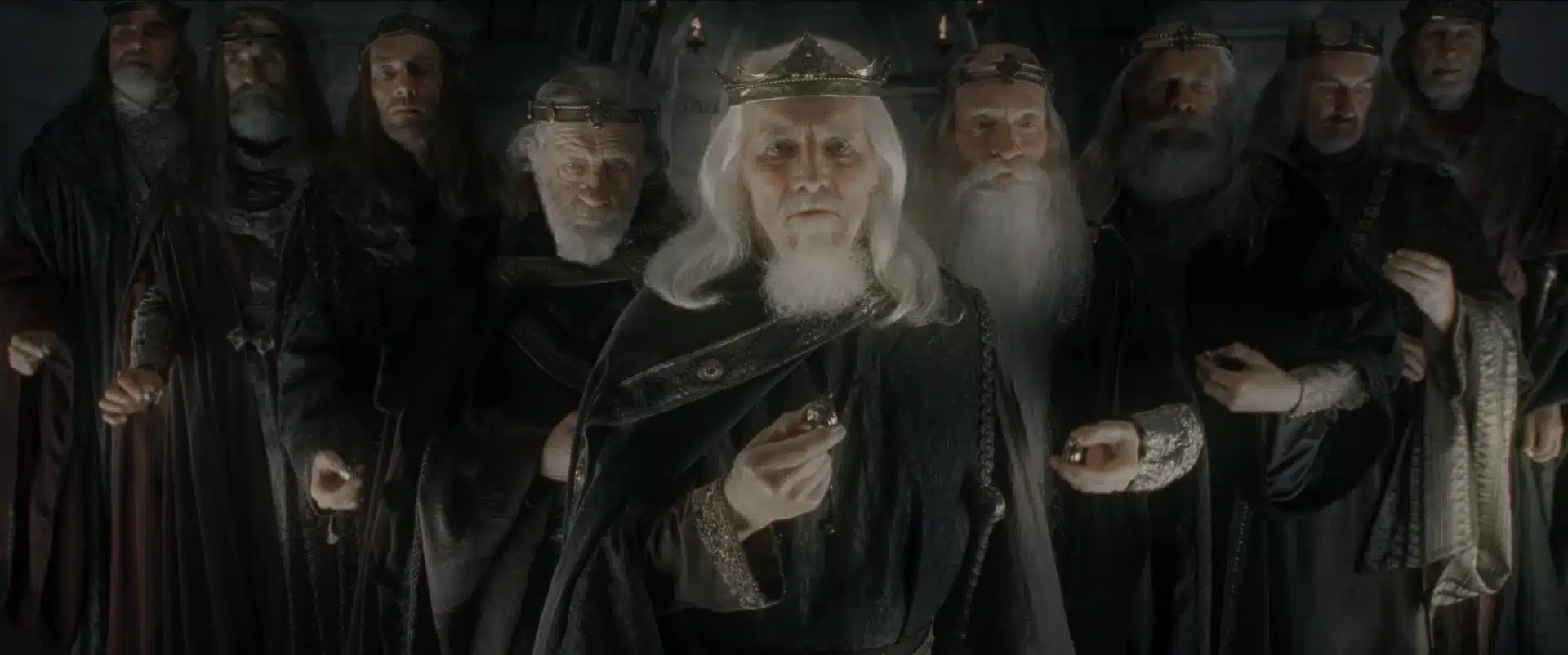
To attempt by device or ‘magic’ to recover longevity is thus a supreme folly and wickedness of ‘mortals’. Longevity or counterfeit ‘immortality’ (true immortality is beyond Ea) is the chief bait of Sauron – it leads the small to a Gollum, and the great to a Ringwraith. JRR Tolkien, Letter 212 In my previous essay on Death and the Half-Elven, I quoted from this letter in order to illustrate Tolkien’s shifting view on mortality and its root in his own fictional world. In this context, the final sentences merely illustrate that this counterfeit immortality was, to Tolkien, a great evil…
Leave a Comment
Recovery, Escape, Consolation These three functions are presented by Tolkien in On Fairy Stories as being the noble and proper graces that Faerie and fairy-tale provides; the functions that both serve in their proper form. Fairy stories, Tolkien says, lend a metaphysical comfort and keen succour to the reader who willingly enters into their sub-created enchantment. This is, in a way, a theological function of Faerie – to provide the reader with some fleeting (though not untrue) measure of spiritual bliss. It is perhaps no surprise that the ideas of Recovery and Consolation have often been considered in light of…
Leave a Comment
In my first post of this year’s September Series, I described Tolkien’s Shire as being a land of people in need of ‘faeriefication.’ The hobbits of the Shire are deliberately blinded to the delights of their Faerie world, and they themselves suffer a deficiency of otherworldly wonder and joy as a consequence of their small-mindedness. This may all seem like rather an unkind take, and though I do stand by it, it is also well worth considering that the Shire is only an unFaerie realm on one level – the level of the Shire itself. For, while the Shire and…
Leave a Comment
This is a relatively short postscript to my recent post on Aragorn and the self-distance he consistently displays in his identifying with his “Strider” identity. In researching and preparing that post, I noticed a really small detail that’s previously escaped me. Right near the beginning of their conversation in the Prancing Pony, Strider offers to the hobbits that he may be able to tell them something to their advantage, and the following exchange takes place: ‘Several things,’ answered Strider. ‘But, of course, I have my price.’ ‘What do you mean?’ asked Frodo sharply. ‘Don’t be alarmed! I mean just this:…
Leave a Comment