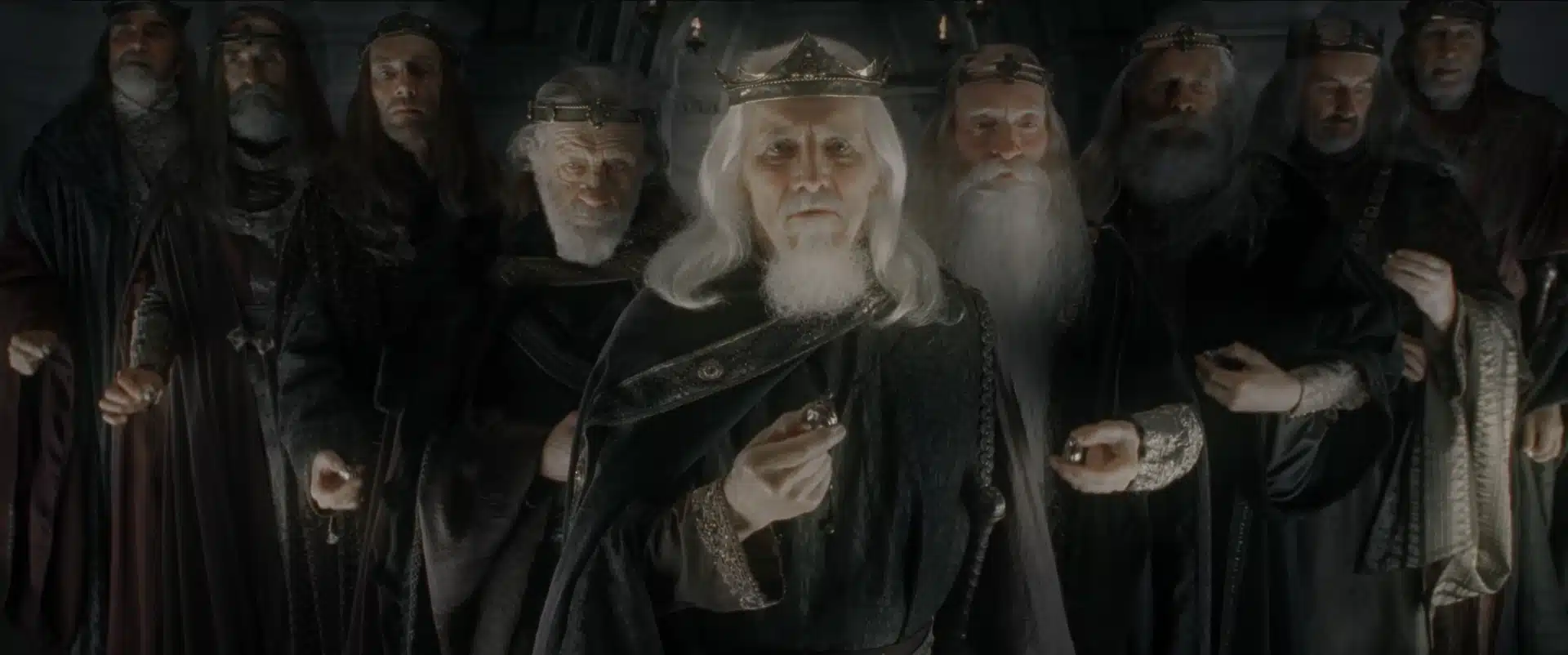
To attempt by device or ‘magic’ to recover longevity is thus a supreme folly and wickedness of ‘mortals’. Longevity or counterfeit ‘immortality’ (true immortality is beyond Ea) is the chief bait of Sauron – it leads the small to a Gollum, and the great to a Ringwraith.
JRR Tolkien, Letter 212
In my previous essay on Death and the Half-Elven, I quoted from this letter in order to illustrate Tolkien’s shifting view on mortality and its root in his own fictional world. In this context, the final sentences merely illustrate that this counterfeit immortality was, to Tolkien, a great evil and chief theme in his works — elsewhere, he writes very fulsomely upon his interest in exploring Death as a theme throughout his works (a theme, naturally, that has inspired and been taken up by this year’s September Series).
However, given that today I am turning to questions regarding the Rings of Power and death, the passage has some fresh significance. The cheap power and false immortality offered by the Rings of Power has, of course, been a matter of fascination to me for many years now — I’ve written about the sentience of the Ring, the reasons why the Ring is inherently evil, the bond between Sauron and the Ring, and the temptations of the Ring. I am, in short, fascinated by the operation of the Ring and the Rings.
As such, when I settled upon this year’s September Series, it felt inevitable that I should turn to the Rings and death. The counterfeit immortality offered by the Rings of Power to mortals is one of the most striking and obviously alluring effects of those instruments. It was this that led to the Nazgûl, and that allowed Gandalf to identify Bilbo’s Ring as being more than it seemed. It is the immortality, not the invisibility, offered by the Rings that drives much of the drama and the tragedy of the tales.
And I am, perhaps unsurprisingly, fascinated by that deathlessness, as I am with so much of Ring-lore. Why is it that a mortal bearing a Ring of Power experiences what seems to be an unending protraction of life? And how, exactly, does that protraction itself work — what rules and mechanisms are there to govern it?
These are the questions that I’m interested in exploring in this essay — exploring, not necessarily answering! Though that being said, I do believe that the texts hint at some very intriguing answers indeed.
It is perhaps not unwise to first offer the reminder that the Rings were made by the Elves (with the “aid” of Sauron) for the Elves, with the view that they be used to preserve and maintain the Elves themselves and their works and kingdoms against the ravages of time. Hence, nearly every commonly-known side effect associated with them actually stems, in effect, from chance. The invisibility, the immortality.
Nearly every, yet not every. The erosion of will, it can be surmised, is at least an original intent and consequence, since this was why Sauron aided Celebrimbor and the smiths of Eregion in the first place — that by gifting these Rings of Power, he might be able to forge the One Ring and thus entrap the Elvish ring-bearers. Yet even in this case, we begin to see the intrusion of unintended consequence. For it was Sauron’s plan that he use the One to bend the wills of the other Ring-bearers to his own. Yet not only did the Elves perceive his purpose when first he put the One Ring on his own finger, but:
Also so great was the Ring’s power of lust, that anyone who used it became mastered by it; it was beyond the strength of any will (even [Sauron’s] own) to injure it, cast it away, or neglect it. So he thought. It was in any case on his finger.
JRR Tolkien, Letter 131
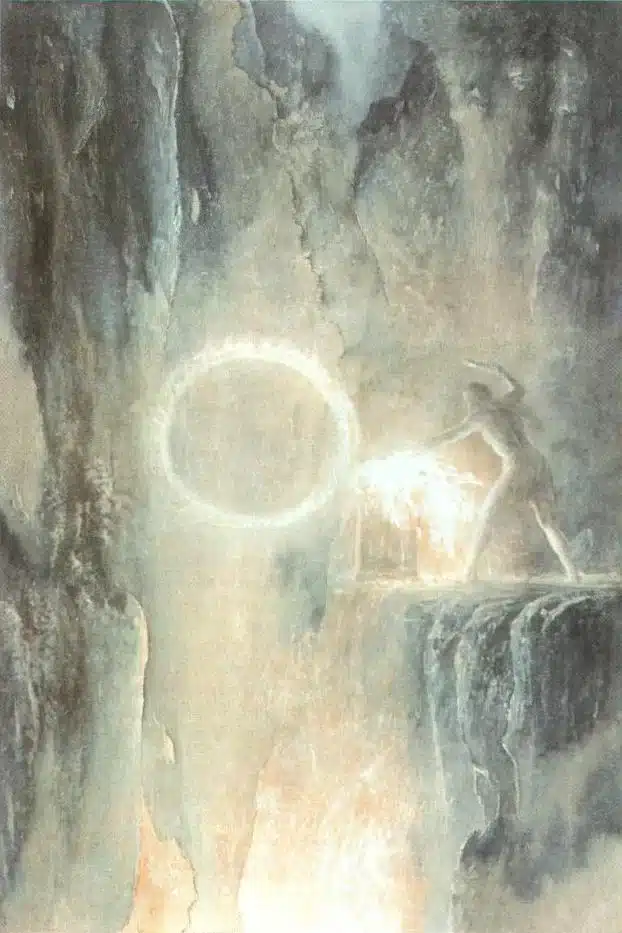
Sauron, too, was consumed by his lust for his Ring — he was no less under its power than the lowly Gollum. It is why he is so easily convinced that the Captains of the West intend to wield the Ring against him, because he can scarcely conceive that any person might even think to destroy it. In short, this insidious power of the Ring operated no less strongly upon Sauron than it did anyone else.
And yet in the case of Sauron, we also start to observe some interesting divergences as regards the operation of the Rings. For it seems likely that Sauron was not rendered invisible by his Ring. Mind, there is no textual statement on this either way (at least as far as I am aware) from Tolkien — yet it seems unlikely to me. We know that Sauron “came forth” from Barad-dûr to challenge the Last Alliance, and that he slew Elendil and Gil-galad (and that it was specifically the heat from his hand that killed Gil-galad), and that Isildur cut the Ring from his finger when he was vanquished.
Is it possible that Elendil and his allies were fighting an invisible foe? Assuredly, though it feels strange somehow. Is it possible that somehow they knew that it was Sauron’s burning hand specifically that killed Gil-galad? I suppose. And is it possible that Isildur, following Sauron’s defeat, groped blindly about for a while, seeking that same unseen burning hand that he might strike the Ring from one of its fingers? …that feels even less plausible.
No, Sauron cannot have been invisible while he wore the One. Yet every single one of its subsequent mortal bearers was turned invisible by it — and given that Sauron obviously never intended that any other hand should wield his Precious than he, that invisibility is clearly an unintended side effect.
One can question why this should be so, and it is a question that we will return to — because the invisibility granted by the Rings is itself rather more complex than may at first seem. Yet before we do so, there is something that must be considered: did the Rings of Power and the One Ring operate in the same way? For while the role of the One Ring was other to that of the Rings of Power, we know that both bestowed ‘immortality’ (or in actual fact, their serial prolongation of mortality: their stretching of a single life without ‘giving’ more), as is made evident by Gollum and the Nazgûl alike.
And in considering this question, it is prudent to turn first back to the invisibility conferred by the Rings, and what we know of it. As mentioned above, the One Ring made all Men invisible, instantaneously and (as far as can be told) without recourse. Invisible, not more — it does not ‘remove’ a wearer to some Unseen World, as has sometimes been suggested. Isildur, Bilbo, and Frodo are all physically wounded by wholly mundane forces whilst wearing the Ring — as, for that matter, was Sauron himself.
Now, as for the Nine Rings of Men, I do not know that it is anywhere stated that these made their bearers invisible immediately. I think it is safe to assume that they did so, though, given the invisibility of their bearers in the later Third Age, and also given a process of elimination regarding the information we have about the other Rings. For it is of note that the Three Rings, at least, did not make their bearers invisible. Galadriel, Elrond, and Gandalf all bear their Rings throughout the tales without becoming imperceptible to sight. Tolkien refers to this in the passage below, in which he clarifies that the Three did not make their wearers invisible.
The chief power (of all the rings alike) was the prevention or slowing of decay (i.e. ‘change’ viewed as a regrettable thing), the preservation of what is desired or loved, or its semblance – this is more or less an Elvish motive. But also they enhanced the natural powers of a possessor – thus approaching ‘magic’, a motive easily corruptible into evil, a lust for domination. And finally they had other powers, more directly derived from Sauron (‘the Necromancer’: so he is called as he casts a fleeting shadow and presage on the pages of The Hobbit): such as rendering invisible the material body, and making things of the invisible world visible.
The Elves of Eregion made Three supremely beautiful and powerful rings, almost solely of their own imagination, and directed to the preservation of beauty: they did not confer invisibility. But secretly in the subterranean Fire, in his own Black Land, Sauron made One Ring, the Ruling Ring that contained the powers of all the others, and controlled them, so that its wearer could see the thoughts of all those that used the lesser rings, could govern all that they did, and in the end could utterly enslave them. He reckoned, however, without the wisdom and subtle perceptions of the Elves. The moment he assumed the One, they were aware of it, and of his secret purpose, and were afraid. They hid the Three Rings, so that not even Sauron ever discovered where they were and they remained unsullied. The others they tried to destroy. In the resulting war between Sauron and the Elves Middle-earth, especially in the west, was further ruined. Eregion was captured and destroyed, and Sauron seized many Rings of Power. These he gave, for their ultimate corruption and enslavement, to those who would accept them (out of ambition or greed).
Letter 131
But, notably, I think we have good reason to believe that the Dwarves, too, could wear Rings of Power without becoming invisible.
For the Dwarves had proved untameable by this means. The only power over them that the Rings wielded was to inflame their hearts with a greed of gold and precious things, so that if they lacked them all other good things seemed profitless, and they were filled with wrath and desire for vengeance on all who deprived them. But they were made from their beginning of a kind to resist most steadfastly any domination. Though they could be slain or broken, they could not be reduced to shadows enslaved to another will; and for the same reason their lives were not affected by any Ring, to live either longer or shorter because of it. All the more did Sauron hate the possessors and desire to dispossess them.
The Lord of the Rings, Appendix A: III ‘Durin’s Folk’, by J.R.R. Tolkien
They could not be reduced to shadows. And there are other passages, too, that point toward the Dwarves being thus untouched by the invisibility of the Rings. There is no hint that the Dwarves of Thorin’s Company (several of whom were close family to Thorin himself, the heir to the throne) suspected anything more of Bilbo’s ring when he found it, save that it was a convenient and useful trinket to have for a burglar — one cannot help but imagine that if there were lore in the House of Durin concerning the Ring that they had borne, there would have been at least some report of its invisibility-conferring abilities, if it possessed them for Dwarves. Yet if not? All the more reason for the Dwarves to be obfuscated and disinterested in trying to guess at its true nature.
That the Dwarves did not constantly bear their Rings (as, for example, the keepers of the Three seem to have) is also clear: it is said that they were kept a closely guarded secret, and we know that Thrór surrendered his ring freely to his son Thráin before he left for his ill-considered attempt to regain Moria. Hence, there is the possibility that they were rendered invisible when worn — but I do not think so. And I think that there is another piece of evidence that suggests against Ring-induced invisibility in the Dwarves yet more strongly again.
For the passage quoted above from the Appendices also points toward something else that may not be immediately apparent with Dwarves — that possessing the Rings of Power did not in any way prolong their lifespan. And this is a fact that is borne out in the lineage and history of the Line of Durin, as presented in Appendix A. Here, we find the Line of the Kings of Durin’s Folk, beginning with Durin VI, slain by the Balrog of Moria, and extending all the way through to Dáin Ironfoot and Durin VII.

Of these, Thráin I is especially significant, because Thráin I is the longest-lived Dwarf in the list (of the Kings, that is — there is one significant exception!), and is recorded as having not died in battle — ergo, most likely of natural causes. Further, we know that Thráin I must have borne the Ring of Durin, being as it was in the keeping of the Kings of the Longbeards until Sauron regained it from Thráin II — and yet Thráin’s lifespan is recorded as having been 256 years.
A mighty span indeed, to be sure, and yet no extraordinary feat for a Dwarf, who regularly lived beyond 200 (as the other names in the lineage attest), and in at least one case, lived well beyond that — Dwalin, Thorin’s cousin (and most assuredly not a Ringbearer) passing away peacefully at the extraordinary age of 340.
Hence, it is entirely clear that the Rings of Power did not render any form of immortality to the dwarves — nor invisibility, given the Dwarvish endurance against the Rings, their resistance to the lifespan-extending effect, and even to the mental domination, and the lack of any record of invisible Dwarvish kings. This then in turn raises a fascinating adjacent question: would a Dwarf have been turned invisible by the One Ring? Or, indeed, would a Dwarf have suffered any erosion of will or other ill effect at all, beyond its potential heightening of their natural avarice?
To the former, I have to guess not. Gimli, or any other Dwarf who wore the One, would not have been turned invisible by it. Nor, I suppose, would their lifespan have been stretched by it. To the latter? Perhaps less so than other mortals (even Hobbits!), yet it feels a little silly and even cheap to assume that the One would have had no dominion over a Dwarvish heart whatsoever. One must turn to Letter 246, in which Tolkien says (speaking of Frodo’s failure to destroy the Ring) that “At the last moment the pressure of the Ring would reach its maximum – impossible, I should have said, for any one to resist,” and must take that statement at face value. A Dwarf may not have been readily conquered by the One Ring, but I do not know that any Dwarf could have conquered it in turn — as, indeed, seems also to have been the case with the Seven.
But, in any case, the prime question holds. There is good evidence that the Great Rings held no sway over Dwarvish visibility or mortality. And given that both these Ring-induced effects are themselves accidental side-effects, unintended by the Elves and Sauron alike, and that the One Ring was forged after the same manner as the Great, I cannot imagine that the One Ring would have rendered a Dwarf any more invisible or immortal.
What, then, of an Elf who bore the One? This matter is both simpler and more vexed. The question of mortality is at least simple enough — the Elves, as serially longeval creatures by their very nature, would be under no ill effect (I presume) from that particular aspect of the One. Indeed, it seems worth reminding at this point that this was the intent and the focus of the Rings of Power as made by the Elves in the first place — that the bearers of those Rings might be able to preserve and maintain the Elvish beauties and works, that they be untouched by the entropic ravages of time.
This, one must suppose, is why Men were rendered “immortal” (in a manner of speaking) by the Rings in the first place — because they, too, were preserved and maintained, as the Elves had wished. But this, of course, was an unnatural preservation and a perverse enduring, a revolt against their nature and a halting of it. Even so, one must guess that an Elf bearing the One would not have suffered this particular perversion — though one must also assume that their will would have been degraded over time, too.
What of invisibility? Would an Elf who wore the One Ring have been turned invisible? To this, I can honestly say that I do not know. On balance, I suspect that it is possible…but that is by no means certain. I also wonder whether for especially mighty Elvish folk, such as Glorfindel and Galadriel, whether they might not have been able to govern such physical effects, owing to their own potency in both the Seen and the Unseen. But this, of course, is merely idle speculation.
And so we come back to Men, the true focus of this study, and arguably the most insightful — because it is only through Men (Hobbits being but a “type” of Man and thus subject to the same broad physical and metaphysical laws) that we see the effects both of the One Ring and of the other Rings. Through Gollum, we know that the One Ring made Men (and Hobbits) invisible, and that the bearing of it (not the wearing of it, which we must return to) prolonged their lives. And we know that the same is true of the Nazgûl. For how else could Gandalf have spoken with any authority whatsoever on the effects of the Great Rings upon mortals when he told Frodo of them in Bag End?
‘A mortal, Frodo, who keeps one of the Great Rings, does not die, but he does not grow or obtain more life, he merely continues, until at last every minute is a weariness. And if he often uses the Ring to make himself invisible, he fades : he becomes in the end invisible permanently, and walks in the twilight under the eye of the Dark Power that rules the Rings.
The Lord of the Rings, Book I, Chapter II, ‘The Shadow of the Past’, by J.R.R. Tolkien
The implication is clear: the Nazgûl were also made invisible when wearing their Rings. Over time, that invisibility became more and more pronounced, until they faded and were rendered wraiths.
From this, though, there are two questions that arise. One is but a tangent, and ultimately (I believe) unanswerable without further clarification: how is one to interpret the claim referenced above that the Three Rings did not render their bearers invisible? For we are never told directly of an Elf bearing one of the other Great Rings that later were given to Men and Dwarves (we are only informed that the Elves “removed their Rings” when Sauron first took up the One and they realised that they had been deceived). Equally, we never see any instance of a mortal bearing one of the Three. As such, there are several possibilities that seem plausible to me:
- One might question whether any of the Three would have made a mortal bearer invisible. The quote indicates not, but I do not know that we can conclude this for sure.
- Further, would any of the Nine or the Seven have made an Elf invisible? If so, then that indicates that the Three were a refinement of the earlier Greats, since invisibility was never really what the Elves were aiming for. If not, then that becomes rather more interesting in a way.
I suppose that ultimately, one must take the statement at face value. An Elf wearing any Great Ring besides the Three would have been made invisible — as such, that particular property of the Great Rings (and the One itself) was a flaw that Celebrimbor was able to overcome or bypass in his making of the Three. But I do think there is sufficient doubt in all of this to at least pose the question.
The other question, though, that can be drawn from the observation above is this: how long did it take to make a mortal into a wraith when they wore a Great Ring? And here, we have several points of comparison that are not instructive in the slightest — and two that are. We can gain no information whatsoever from most bearers of the One Ring — Isildur, Bilbo, Frodo, and Sam (yes, Sam!) bore and wore the One Ring for far too few years to become wraithified.
The Nazgûl, conversely, evidently all wore their Rings for long enough that they permanently faded — this is clear. What is rather less clear to me, at least, is when that fading might have occurred.
The Nine (and the Seven) Rings were seized by Sauron in 1697 S.A., when Eregion is laid waste and Celebrimbor slain. Clearly, Sauron cannot have distributed any Rings to Men before that date. We are then told in the Tale of Years that the Ringwraiths “first appear” in 2251 — some 450 years or so later. What we do not know is whether all the Nine became known at once, or whether (as I think is more likely) they continued to fall under Sauron’s spell over the next hundred years. It is clear that all Nine were fully under Sauron’s dominion by the end of the Second Age, however, in 3441 — i.e., well over a millennium and a half after Eregion.
We also do not know if those Ringwraiths in 2251 were “truly” wraiths, or simply Men who by then could no longer be parted from their Rings (a point to which I will return). In short, it is unclear on what timescale we are operating — but to that, we have an additional point of comparison, and arguably the most informative of them all.


Sméagol and the Ring, by Anke Eißmann
For around the year 2463 of the Third Age, a young hobbit chanced upon one of the Rings of Power, and bore it and wore it for many centuries without becoming a wraith. For nearly five hundred years, Gollum is in possession of the One, until Bilbo happened to gain it from him. We know that Gollum does not perpetually wear the One, but he seems to have used it as a matter of habit, and never for any good purpose.
And yet, despite the presumed frequency of Gollum’s Ring-usage, he is not a wraith. How close he may have been cannot in any good faith be guessed at — it is difficult to imagine that he would have endured another five hundred years, but we know so little about the process that it cannot be said for sure. What that does tell us, though, is that those first Ringwraiths to appear in the Second Age must have used their Rings very often indeed, to have been already so faded. And it is a reminder that for Gollum, fading would have been an inevitability, not a possibility.
Yet there is a further point of interest in the case of Gollum and the Nazgûl alike, and one that brings us back around to what is ostensibly the point of this essay — their mortality. For the words from Gandalf quoted above about a mortal who “keeps” one of the Great Rings not dying are not, I think, wholly accurate (with apologies to Gandalf for challenging his wisdom). It would be better to say that a mortal who has kept a Great Ring will not die, save by accident or violence.
For there are numerous passages that indicate that the Ringwraiths do not bear their Rings, and yet they endure. Frodo does not see any Ring upon their fingers on Weathertop. When the Witch-king is slain on the fields of the Pelennor, there is no indication that Gandalf or Aragorn sees fit to search for and seize his Ring. Galadriel also indicates to Frodo that Sauron “holds” the Nine — and perhaps most tellingly, Tolkien makes the same claim himself in both the Hunt for the Ring, in Unfinished Tales, and in Letter 246, in which he says of the Nazgûl that, “…Sauron, who still through their nine rings (which he held) had primary control of their wills.”
At the Council of Elrond, we see the sole indication that the Ringwraiths are still in possession of their own Rings, when Gandalf claims that “The Nine, the Nazgûl keep.” But Gandalf is no great scholar of Ring-lore (as is made painfully obvious in other moments), and besides, may have seen fit to simplify the truth of the matter in the moment.
One might also fairly question how exactly Sauron was able to control the Nazgûl when he himself did not wield the One, as was the case for the entirety of the Third Age. Both Letters and Unfinished Tales make this clear: he did so by possessing their own Rings and thus ever impelling their wills toward his own ends.
This would also suggest, I believe, that there are two possible moments in history when Sauron might have taken the Nine back: either at some indeterminate point during the Second Age, or early in his return to power during the Third, likely before the year 1,000 (when Mirkwood fell under his shadow). In either case, though, this leaves millennia in which the Ringwraiths simply…endure. Bereft of their Rings, and yet undying, at least until slain.
To put it another way, it is not that it is enough to bear a Great Ring — one need simply have borne it, and if one has done so, then they will endure…a life stretched without more life.
And again, Gollum provides yet more evidence as to the truth of this — as does Bilbo, to a lesser extent. For we do not know how old Smèagol was when he went fishing on the Anduin, but he is presumably not old, for it is his grandmother that banishes him from his clan. As such, I would put it that he is not younger than 20, but certainly no more than 50, and likely younger. Then, for near-500 years, he bears the Ring — until it is “stolen” by Baggins.
But upon Bilbo taking the One Ring, that time does not catch up with Gollum. Not only that, but when Frodo meets him, some 78 years later, he is starved and wretched…and yet still seems hale and hearty, and is congruent enough with Bilbo’s description of him that Frodo is in no doubt as to his identity. Yet, even assuming that the hundreds of years that Gollum possessed the Ring “don’t count” as to his biological age, this still means that Gollum is, at the youngest, nearly 98. A century or more old, and yet still a wily and capable hunter, swift and deadly and strong — and not, it seems, diminished in any meaningful way from when Bilbo met him beneath the Misty Mountains.
As for Bilbo himself? He surrenders the One Ring on his 111th birthday — and yet, when Frodo reunites with him some seventeen years later in Rivendell, there is no attention called whatsoever to his having changed physically (as can be contrasted with Frodo’s impression of Gandalf in that same year, in which the hobbit thought that the wizard seemed both older and wearier). Bilbo is, perhaps, somewhat more dozy in Rivendell than he had been in the Shire, but there is no indication that he has aged at all…despite having given up the Ring many years ago.
And if it is merely enough for a mortal to have borne a Great Ring, what does that imply for the other possessors of the One? It is, perhaps, a mercy in hindsight that Isildur was slain as he was, for imagine the alternative — an ever-wearying and unending King of Gondor and Arnor, enduring even as his subjects and their descendants failed, even if he had proven capable of surrendering the Ring to Elrond as he intended. Bilbo, Frodo, and Gollum, all enduring, all undying.
And Sam. For Sam, too, bore the One Ring. He thought of himself, if however briefly, as its keeper, and he wore it and wrestled with it. It is a horrifying thought, that even this passing encounter of Sam’s with the One Ring (according to the Tale of Years, he bore it for two or so days), might have rendered him undying, might have so stained his very nature. And yet I cannot see why it would not have been so. It would seem odd to me if it took a significant passage of time for the Ring to take hold.
And this, then, brings us to the final question that I intend to pose in this article: did this particular power of the Ring end when it was destroyed, or did it endure? Could Bilbo, Frodo, and Sam have died in Middle-earth?
For one side of the argument, there is the following quote from Gollum, when confronted by Sam on Mount Doom:
‘Don’t kill us,’ he wept. ‘Don’t hurt us with nassty cruel steel! Let us live, yes, live just a little longer. Lost lost! We’re lost. And when Precious goes we’ll die, yes, die into the dust.’
The Lord of the Rings, Book VI, Chapter III, ‘Mount Doom’, by J.R.R. Tolkien
But I do not think that we can take Gollum’s word as holding any sort of authority. I do not doubt that Gollum truly believes that he will die when the Ring is destroyed, given its insidious and near-unshakeable hold upon his mind. But it is that very hold that renders him unreliable.
Then there are the Nazgûl, whose own Rings are not physically unmade, but are rendered impotent by the destruction of the One. Yet the text is intriguingly ambiguous as to whether they are destroyed by the destruction of the Ring, or whether they are caught in the physical carnage rendered by its unmaking.
Towers fell and mountains slid; walls crumbled and melted, crashing down; vast spires of smoke and spouting steams went billowing up, up, until they toppled like an overwhelming wave, and its wild crest curled and came foaming down upon the land. And then at last over the miles between there came a rumble, rising to a deafening crash and roar; the earth shook, the plain heaved and cracked, and Orodruin reeled. Fire belched from its riven summit. The skies burst into thunder seared with lightning. Down like lashing whips fell a torrent of black rain. And into the heart of the storm, with a cry that pierced all other sounds, tearing the clouds asunder, the Nazgûl came, shooting like flaming bolts, as caught in the fiery ruin of hill and sky they crackled, withered, and went out.
The Lord of the Rings, Book VI, Chapter III, ‘Mount Doom’, by J.R.R. Tolkien
Arguably the best case comes from Bilbo himself. For on returning to Rivendell after the Quest, the hobbits meet Bilbo again, and now (in contrast to earlier) the text tells us that he looked “very old.” And indeed, it becomes sadly clear in the pages and chapters that follow that the years have caught up to Bilbo, both mentally and physically.
And yet he does not die. One hundred and thirty-one years old, and he does not die. Longevity is, to be fair, in his genes, for the Old Took, his grandfather (the previous oldest hobbit ever recorded) reached his 130th birthday. It is thus inconclusive as to whether Bilbo would have passed away in Middle-earth or not…his great age is an improbability, but not an impossibility.
And yet. And yet I think it is more interesting to at least consider the possibility that Bilbo would not have died in Middle-earth — or at least, that to do so would have been a great pain and a difficulty for him, and for Frodo, and for Sam (who likewise outlives at least his wife, Rosie). I have written previously on the passing of these three Hobbits over the Sea, and dwelt there upon the idea that the West was a mete Faerie-experience for the three Ring-bearers — in contrast to Merry and Pippin, whose “Faerie” was satisfied by their desire to return to Rohan and, at the end, Gondor. Yet to think of this healing over the Sea as being fit for the Ring-bearers reveals that the Ring still bore some sort of mark upon them that could not be negated by earthly power, despite the complete unmaking of the Ring itself.
‘Alas! there are some wounds that cannot be wholly cured’, said Gandalf (III 268) – not in Middle-earth. Frodo was sent or allowed to pass over Sea to heal him – if that could be done, before he died. He would have eventually to ‘pass away’: no mortal could, or can, abide for ever on earth, or within Time. So he went both to a purgatory and to a reward, for a while: a period of reflection and peace and a gaining of a truer understanding of his position in littleness and in greatness, spent still in Time amid the natural beauty of ‘Arda Unmarred’, the Earth unspoiled by evil.
Bilbo went too. No doubt as a completion of the plan due to Gandalf himself. Gandalf had a very great affection for Bilbo, from the hobbit’s childhood onwards. His companionship was really necessary for Frodo’s sake – it is difficult to imagine a hobbit, even one who had been through Frodo’s experiences, being really happy even in an earthly paradise without a companion of his own kind, and Bilbo was the person that Frodo most loved. (Cf III 252 lines 12 to 21 and 263 lines 1-2.) But he also needed and deserved the favour on his own account. He bore still the mark of the Ring that needed to be finally erased : a trace of pride and personal possessiveness. Of course he was old and confused in mind, but it was still a revelation of the ‘black mark’ when he said in Rivendell (III 265) ‘What’s become of my ring, Frodo, that you took away?’; and when he was reminded of what had happened, his immediate reply was: ‘What a pity! I should have liked to see it again’.
JRR Tolkien, Letter 246
The mark of the Ring. Here, Tolkien refers to that mark in psychological terms — yet if it is wholly and solely psychological, why would it be necessary to heal the Ring-bearers in this Purgatorial manner? What metaphysical wound did the Ring leave upon them, that it could only be cured by tarrying near (though not in) Paradise?
It is, ultimately, too much of a stretch to assume that the Ring-conferred immortality would have continued beyond the unmaking of the Ring itself. And yet, I do think it is likely indeed that all three of these Ring-bearers could not have passed away peacefully. It is my belief, given the weight of evidence and the information available, that for them to have died in Middle-earth would have been a torment and a burden: a dreadful conflict between their nature as mortals and the stain of Elf-like eternal perseverance that had marked their beings.
And it does cause me to wonder: had Gollum or any of the Nazgûl survived that final violent catastrophe, would they have died immediately? Or would they, too, have endured for at least a little while, tortured by the immense burden of having borne a Ring of Power? And if that had been the case — would there have been any possibility of them, too, passing over the Sea? I cannot imagine that such grace would inevitably have been granted to them, or that they would have accepted it. Yet there is a comfort, I think, in imagining that it was at least a possibility for them, too — if a possibility that they never would have accepted.
This has been a long and meandering essay, and one that is ultimately without much of a point! And yet, as I mentioned at the beginning, it is one that I think possesses some merit. These specific questions of how the Rings intersect with and interact with mortals are raised less often than I think they deserve. Much of it may seem self-evident — and yet beneath the surface, there is a whole host of ambiguities and details that paint a very rich and very intriguing picture, especially as regards the dual invisibility-when-worn and immortality-when-borne (or indeed, having borne) the Rings. The Dwarvish relationship with the Rings, though relatively clearly spelled out by Tolkien, is one that deserves more attention, and one that reveals several idiosyncrasies that may well seem counterintuitive to a reader.
Yet ultimately, it is the manner in which the Rings pervert mortality that most fascinates me. That this side-effect is due to the intended purpose of the Rings as preservers and sustainers, forged by beings with a profoundly alien perception of Time and decay, seems self-evident. Yet the metaphysical grip that any Ring has upon its mortal bearer — even beyond the ending of the Rings themselves — reveals something of the true power of these devices, and the near-indelible mark that they leave upon their mortal bearers…a mark that is, perhaps, only within the power of the gods themselves to erase, and a mark that may well have otherwise endured beyond even a mortal lifespan.
~~~~~~~~~~~~~
Thanks for reading – feel free to check out anything else you may be interested in on the blog, there’s plenty more to discover! Follow me on Facebook and on Twitter to stay up to date with The Blog of Mazarbul, and if you want to join in the discussion, write a comment below or send an email. Finally, if you really enjoyed the post above, you can support the blog via Paypal, and keep The Blog of Mazarbul running. Thanks for reading, and may your beards never grow thin!