
Sadness is, perhaps, not an emotion that is often associated with the myriad feelings surrounding generative AI.
Anger, despair, fear, suspicion — these will likely be familiar to some. I must confess, I do not as of yet truly understand the more positive emotions some seem to have toward AI LLMs, and so I will not speak to them.
Sadness, though, is perhaps not the most obvious emotion — and yet I think it is the one that best describes how I feel about generative AI, and how I have felt for some time. Or, rather better, how I feel about how it is used, and how it is often used to fail to solve a problem — and a problem that should not exist in the first place.
I’ve written about generative AI once before, if obliquely (though if I may say so myself, not really that obliquely), and what I think about it remains more or less wholly unchanged. Unchanged, certainly, in my greatest concerns surrounding it. The tendency of generative AI to misidentify and misconstrue information. Its diverting of readers away from legitimate journalism and research via its own brainless synthesising. Its enormous environmental footprint, both in resources consumed and in infrastructure demanded to support.
And, of course, there is its economic footprint: the undeniable fact that every AI company as-is, both big and small, is haemorrhaging money. But I want to come back to that point later.
Even for many use cases where it could be useful, it seems lacking to me. Take, for example, the possibility of using generative AI to write a bibliography, or to create a list for further reading. These are tasks that I could imagine an AI-like program doing relatively well, being as that they are fairly machinistic and repetitive tasks in the first place.
But all LLM models are, as far as I have seen, far too prone to error for me to really trust them with such a process. They are far too prone to hallucinating and inventing sources, to spinning out the next plausible word without any actual duty of care. And further, if the models are prone to hallucination, who is to say that they are not ignoring material when called upon for such a task? The hallucinations are easy (or at least, easier) to identify than the errors of omission, given that the latter leave no trace.
But none of these observations are especially novel, nor are they responsible for the actual sadness that I do think best encapsulates how I feel about generative AI and its place in the world as it stands.
(There is one issue that I have with generative AI that I do believe is not yet widely discussed nearly enough, and that is the opacity of its processes in synthesising and presenting information. Put simply, I do not like the fact that it would be trivially easy for any particular generative AI to exclude any particular source in its responses to prompts. That this is already happening to some degree should be manifest in that AI models do not, for example, regularly cite news from The Onion — despite that august source having operated for decades, reporting on a broad variety of topics in a seemingly serious tone. Now, obviously, if one is looking for serious research, excluding satire and misinformation is necessary. But how is it possible to know what legitimate sources may be excluded by generative AIs via the very same processes that also discount the humorous ones? Whether for political or personal or petty reasons, what processes and measures are currently in place to police such invisible censorship?)
(Seriously, this really does scare me. I don’t think enough people are talking about the ease with which generative AI can censor, nor about the lack of measures in place to ensure that it does so in a responsible and well-considered manner, and one that does not necessarily serve the pleasures of the companies behind various LLMs. Because I am sure that, given that they can exclude sources pretty much at their own whim? That means that they are excluding sources, right now.)
All of that aside, though, I do want to linger upon one particular issue that plagues generative AI: namely, its ability to actually produce an “accurate” answer. For some things, it does very well indeed — typically those matters which are both widely reported upon, and which have something of a consensus as regards them. For these, then, the question must be asked: of what use is generative AI, given how readily an answer can be generated by other, less ecologically and economically problematic means?
Then, when it comes to many other issues, it struggles to produce an accurate answer. If something were true in 2025, and is no longer true in 2026 (say, for example, some given law)? Odds are just as good that the AI will cite the earlier thing instead of the current. If there is relatively little written on some particular topic, or if the information that exists is contradictory and needs to be further verified, or if there are two, similarly-named topics? Again, odds are good that the answer generated by an AI will be inaccurate or completely false.
One is reminded of Erwin Knoll’s law of media accuracy: “Everything you read in the newspapers is absolutely true except for the rare story of which you happen to have firsthand knowledge.” So it is with generative AI — it is all too easy to believe it, thanks to the confidence and speed with which it delivers seemingly conclusive information, unless one happens to know something of that which it is answering. Yet if one already knows the answer, why ask? And if one does not, then how can the answer be trusted?
Even certain tasks that machines are traditionally quite good at routinely prove too demanding for generative AIs. Take the many comical examples of LLMs trying to play chess (a particularly excellent example is included below), or do simple maths, or produce lists.
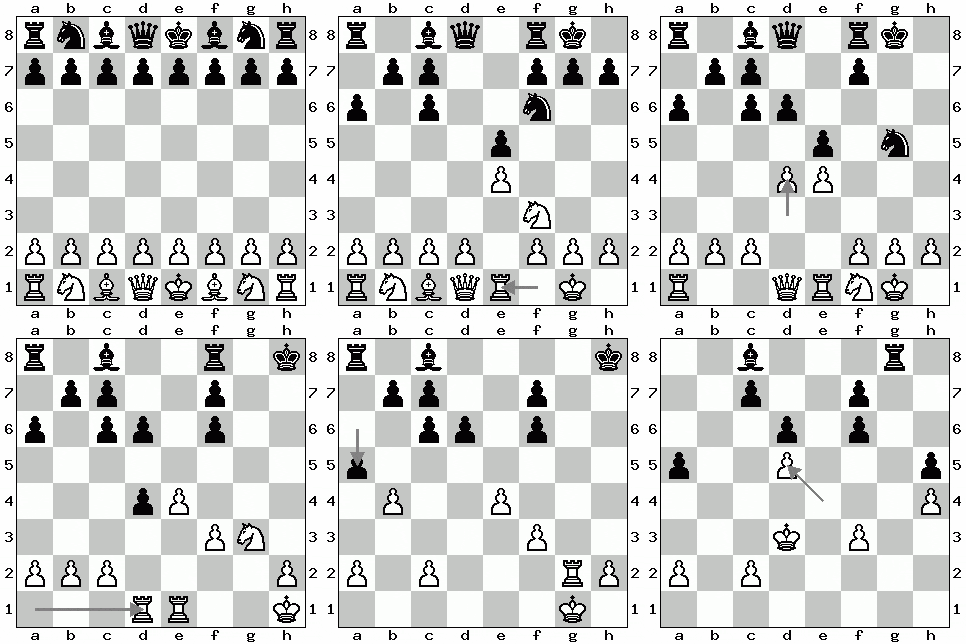
The point to all of this being, if generative AIs promise to easily provide the “right” answer to things, only to routinely and catastrophically fail at producing that answer, then what is the very promise behind them worth? Why use generative AI at all when it cannot be relied upon to do the thing that it promises?
Then, all of that aside, there is also the inherent mediocrity of anything produced by generative AI. I am not exaggerating when I call it ‘inherent,’ either — and to describe it as being ‘mediocre’ might very well be the most accurate use of the word possible.
AI-generated content is mediocre, pure and simple. And it has to be. It is an average, a billion billion words reduced to the mean, a flattening of all the best and worst things ever written in every genre and across every time period into a single beige void.
And there is an interesting process there, in that one can claim that it makes those writers who are worse than average (and statistically, there are obviously quite a lot of them!) rise to the average. That, one might argue, is a good thing.
But I disagree with the framing of that perspective. I think it would be better to say (and certainly truer) that a less-capable writer who uses generative AI to produce text will simply become better at producing material that is exactly average. It does not make them a better writer, and this is crippling. They will never rise one whit beyond utter mediocrity. Indeed, I am sure that over time, it will make them worse at writing, not better, because they will not be honing and working on those skills, and thus will become ever-more dependent upon the use of machines that are in themselves deeply unreliable.
I suppose that not everyone wishes to become a great writer, and it is a fine thing to not wish for this. Yet even so, to actively cripple and stifle ones own possibilities seems a terrible shame to me. And, having been seduced into using such machinery, I worry that it will not easily be escaped. Why seek the light, when the darkness is so very easy?
But the damage done to the person is perhaps less terrible than the damage done to art itself (and that is a significant claim, given the evidence that prolonged AI usage can be terribly damaging to an individual indeed), for when the average and the standard and the banal becomes ‘good enough,’ then a great deal is lost. Art itself becomes worse, and not only worse, but worse without prospect of betterment.
Much of art has never been very good, of course; but it has at least been produced and practiced with the possibility of improvement — with the goal of self-improvement. One does not begrudge a sketch because it is not a masterful oil painting, nor the experiments of the teenage JS Bach because they are not the masterpieces that he was composing with regularity not ten years later.
One does not begrudge such works, but one does and must judge them according to a standard. One cannot look at such a sketch and see the oil painting, though one might appreciate beauties within it inherent to its own form, or come to some fresh understanding of the painting’s composition and process. One may even be more moved by the sketch than the painting — but even then, it is likely either a particularly fine sketch, or there is within it some added significance through the story of its inspiration or realisation.
The point that I am making is that this is wholly lacking in AI texts and images (I do not and will not call them art, for they are not). There is no joy to be discovered in them, unless it be a fleeting and often-ironic amusement. And (and I think this is far more significant) there is no possibility of masterfulness. It is AVERAGE. Truly and profoundly average. It will always be average, and will only become more average over time, as more and more material is heaped upon the great mound and fed blindly into the gaping furnace of the algorithm.
And such sustained mediocrity is a damning indictment upon AI-generated works. Again, I cannot stress enough, there is real and demonstrable damage being done to those who insist upon systemically using AI — the term ‘cognitive surrender’ being a singularly compelling one to express the damage done by generative AI systems. But the damage goes beyond harming the self, into devaluing the intangible. When ‘utterly average’ is considered the acceptable standard in artistic practice, all arts will inevitably be lessened.
In art, the best is the standard. When you hear a new violinist, you do not compare him to the kid next door; you compare him to Stern and Heifetz. If he falls short, you will not blame him for it, but you will know what he falls short of. And if he is a real violinist, he knows it too. In art, “good enough” is not good enough.
From Elfland to Poughkeepsie, by Ursula K. Le Guin
Le Guin’s words may have been taken out of context and reapplied here, but that does not make them any less pertinent. Anyone who accepts AI-generated work as being ‘fine’ or ‘good enough’ is not just eroding the possibilities of their own creative practice, but is diminishing the very stuff of Art itself: rendering it not an ideal to be striven for, but a test to be passed, a middlingly difficult benchmark to be achieved.
And this, at long last, brings me to my actual purpose in trying to articulate my sadness when thinking about generative AI: that it betrays a far wider problem in perception as regards art in the first place. Anyone who uses generative AI to form their own texts or form their own videos is seeing the art not as something to be created, but as a problem to be solved. They are being told that art is a commodity: a thing to be produced and sold and bought, and that it has utterly no worth beyond that. Art that does not serve some banal purpose is useless, and art that does serve such a purpose is ideal.
In this sense, the banality of AI-produced content can even be seen to be a feature, not a bug. It is a banal thing, produced through a banal process, for a banal purpose.
Art must be commodified in some form, of course, in order that the artist make a living. But the proponents of AI-generated content see nothing more to art than the commodity. It is a thing not admirable for itself, but notable for being desirable. In this understanding, the need to produce so-called art that is “good enough” is entirely coherent. So long as the content is indeed good enough that it can be traded in, it is serving its wretched purpose. It need not aspire to more, for there is nothing more to be aspired to. There is no joy to be had in the producing of it, and there need be none.
This, then, comes to questions of what art is and what it should be. I have, I think, made my own position on this question relatively clear before (and I want to return to Leaf by Niggle soon). But the joy of producing art is, I think, something that can be agreed upon by some, regardless of theological convictions. Art is beautiful because it is made, and the making of it is itself joyful. The proponents of generative AI do not and can not recognise that beauty, and so eliminate the joy. To them, art is nothing more than something to be made and sold. Its making is not a delight, but a problem, and that problem has now been solved and eliminated by virtue of the enslaved machines churning out content.
And at this point, it is well worth reiterating the fact stated above that generative AI is genuinely quite bad at fulfilling the promises under which it is sold. It is sold as solving a problem (the making of art), and yet demonstrates extraordinary and crippling inadequacies that make it near-totally incapable of actually solving that problem, and it must be questioned again and again whether this was a problem that ever needed solving at all.
I came to this realisation, that AI marketing posits the generation of art as being a problem to be solved, when thinking about the widespread use of generative AI in schools and universities to “pass” (ie, cheat) homework and tests. It is, on the face of it, nonsensical that any serious student should do so. The purpose of any and all such homework and tests should be to teach something to a student, whether it be the introduction of a new concept, the practice of a method, or the synthesising of multiple ideas. To use generative AI to circumvent such learning opportunities means, simply, that the things will not be learned, despite the nominal purpose of such institutions being the teaching of them.
Nonsensical. And yet I do not know that it is the fault of the students using these AI tools, not entirely. I think that the very education system has to take some blame (and society as a whole) in that the very framing of such homework emphasises not its developmental aspect, but as being something to be “passed” or “failed.” A benchmark to be achieved. A result to be had.
And genuinely, when that is the end goal? Why not aim for good enough? What irrationality is there in any student who would turn to such a tool, given that the tool promises (and can more or less deliver) exactly what is demanded in their situation?
If the goal of a test is only that it be passed, then there is nothing at all wrong in passing it by any means necessary. It is the goal that must be considered suspect and re-examined, not the method used to overcome it. Obviously, the actual goal must be that some idea or method is taught, learned, and understood by the student through the test — but given how awfully results-based education across much of the world has become, and how results-oriented industry in general is, it is not difficult to see how the “true” goal can (and, I believe, has) be so easily lost sight of.
The perceptive reader may notice that I have at this point switched focus away from generative AI and its impact upon art, to its impact upon learning. The thing is, however, that this commoditisation and producing-centric focus impacts the arts just as much as it impacts education.
In a world of AI-generated text and imagery, the product — the end result — is the goal, and nothing more. It can be boiled down to its practical and its economic use, with resources going in and a commodity being spat out. And it is with this in mind that I want now to return to Tolkien’s Leaf by Niggle, which was briefly cited above, and to the argument framed toward the end of the short story between Councillor Tompkins and Atkins, who find themselves debating the merits of Niggle as an artist.
‘I think he was a silly little man,’ said Councillor Tompkins. ‘Worthless, in fact; no use to Society at all.’
‘Oh, I don’t know,’ said Atkins, who was nobody of importance, just a schoolmaster. ‘I am not so sure; it depends on what you mean by use.’
‘No practical or economic use,’ said Tompkins. ‘I dare say he could have been made into a serviceable cog of some sort, if you schoolmasters knew your business. But you don’t, and so we get useless people of his sort. If I ran this country I should put him and his like to some job that they’re fit for, washing dishes in a communal kitchen or something, and I should see that they did it properly. Or I would put them away. I should have put him away long ago.’
…
‘Of course, painting has uses,’ said Tompkins. ‘But you couldn’t make use of his painting. There is plenty of scope for bold young men not afraid of new ideas and new methods. None for this old-fashioned stuff. Private daydreaming. He could not have designed a telling poster to save his life. Always fiddling with leaves and flowers. I asked him why, once. He said he thought they were pretty! Can you believe it? He said pretty! “What, digestive and genital organs of plants?” I said to him; and he had nothing to answer. Silly footler.’
Leaf by Niggle, by JRR Tolkien
I am often leery of statements such as, ‘Tolkien would have liked this, had he lived to see it,’ or ‘Tolkien would have disapproved of that.’ Usually, the statements reveal more about the person stating them than they do anything about Tolkien, and in any case, worthy a fellow though Tolkien seems to have been, his own likes and dislikes cannot form any sort of a comprehensible basis for moral practice.
Nonetheless, I will confidently walk into the trap I have prepared for myself: I do not know exactly what Tolkien would have made of generative AI. But I am confident that Councillor Tompkins would have approved exceedingly of it. An artist (if you will, and Tompkins will) that is constantly and enthusiastically willing to churn out posters and pamphlets and banners. An advisor that neither needs advising, nor challenges your own advice. A machine with the manner of a man that is not afraid of new ideas and new methods, for it does not fear. Reason and doubt are inscrutable to it: all that matters is the generation of something to satisfy the self-satisfied Tompkins engaged in using it.
Councillor Tompkins would have approved of generative AI. And I am not sure that I can construct a more damning criticism than this.
And this is, in short, my great sadness with generative AI as a whole. Generative AI is in and of itself nothing but a tool, and for the most part, an exceptionally mediocre one that I have little use for. There are, to be clear, many use cases for AI programs and models, and I hope that the technology can be refined and iterated upon, and that its current excesses and imperfections be curbed. This essay is not an exhorting to the abandonment of all AI as a whole, but rather a reflection upon what precisely it is that generative AI offers to the world, and whether it truly fulfils the promises that its makers spin, or whether there really ever was a problem to be solved.
I contend that generative AI does not, and there was not. I contend that those excesses and imperfections are vast and deeply ingrained within the very nature of these fancy text predicting machines. To reiterate, I do not like the high error rate, nor the average and mediocre nature of the output, nor the ease with which that output can be and will be (if it is not already being) manipulated. I do not like its vast environmental footprint, nor its detrimental economic impact. I do not like the way in which it usurps the decision making processes of people when relied upon, especially given the litany of other issues already listed above.
But most of all, I suppose, I do not like generative AI because it reveals a deeply uncomfortable and tragic problem that it did not cause, merely illuminated. It reveals that there is a broad disinterest in the very process of asking questions and discovering answers through exploration and reason and discussion.
AI promises that it will find the “right” answer to a problem. It is with this promise that it is sold, and it is with this promise that it must be sold. At present, AI is singularly bad at fulfilling that promise, due to the extraordinary and crippling lacks that continue to plague it years after it arrived as a force, and the very systems that underpin its functioning and make such lacks a certainty. And yet it is that promise that must be sold, in order that the firms behind generative AI be able to create a perceived reliance and start turning a profit.
The philosophy that underpins the need for generative AI is one that posits a world in which there is no discovery and exploration and nuance. There are not questions to be considered and delighted in, merely questions that demand answer in the name of hellish progress. There is no debate, no development of skill and thought, no challenge, and no joy in creation. There is merely The Machine, and its soulless and utterly banal pseudo-answers to every problem you may ever put to it.
And the above-listed crippling problems with AI aside, my sadness stems from the fact that so many people are willing to buy into this promise at all. That so many people seemingly believe that there is some right answer to be had, and show such disinterest in the process of developing and discovering an answer.
I do not doubt that this is the world that some strive to achieve. But it is not my world. I refuse it, and it breaks my heart that there are those who embrace it.
I will not walk with your progressive apes,
erect and sapient. Before them gapes
the dark abyss to which their progress tends –
if by God’s mercy progress ever ends,
and does not ceaselessly revolve the same
unfruitful course with changing of a name.
I will not treat your dusty path and flat,
denoting this and that by this and chat,
your world immutable wherein no part
the little maker has with maker’s art.
I bow not yet before the Iron Crown,
nor cast my own small golden sceptre down.Mythopoeia, by JRR Tolkien
I will not cast my own small golden sceptre down.
~~~~~~~~~~~~~
Thanks for reading – feel free to check out anything else you may be interested in on the blog, there’s plenty more to discover! Follow me on Facebook and on Twitter to stay up to date with The Blog of Mazarbul, and if you want to join in the discussion, write a comment below or send an email. Finally, if you really enjoyed the post above, you can support the blog via Paypal, and keep The Blog of Mazarbul running. Thanks for reading, and may your beards never grow thin!