
It is, I think, sometimes overstated by Tolkien readers just how important the death of Boromir actually is.
I do not wish to be misunderstood! Boromir is an important character in his own right, for what he reveals about Gondor as our first representative of that land, and for what he illustrates as regards the insidious dangers of the One Ring. And his death is important, too, for what it sets in motion on a narrative level, and for its serving as proof of his own rejection of temptation and the regaining of his moral fortitude following his weakness.
But here is the thing. Boromir’s death is immaterial when it comes to that regained virtue. That he dies is, to be sure, as certain a proof of his heroism as one can gain, and so his dying is important! But he did not need to die, either. Had Boromir acted as he did in the tale, and yet by some chance not died, his redemption would have been every bit as absolute as it was in the tale. It may not have been a completed redemption, for in living, he would clearly and obviously have continued to be subject to temptations old and new — not completed, but also complete (or at least, as complete as any such matter can be in a fallen world).
So far, this series has been concerned with the mechanics of death in Middle-earth. With the nature of choice granted to some within Tolkien’s writings, and how to make metaphysical sense of this; and with the operation of the Rings of Power upon mortals and their mortality. For this article, the last in this year’s Series, I will be examining death from a rather more character-driven and personal angle. How do the deaths of various characters inform our understanding of that character, and what does it tell us in light of other deaths? And what of characters who do not necessarily die, and yet have a relationship with death?
But I am getting ahead of myself. First, I wish to return to Boromir, and to a very broad swathe of character deaths in Tolkien – those deaths which might be described as being ‘redemptive.’
As described above, this seems to me a somewhat misleading term to use. Boromir is not redeemed through death, nor does he redeem anyone else. Rather, he dies because he has accepted redemption – because he has realised the grave error into which he fell through coveting the Ring and threatening Frodo, and has accepted anew his duty as a warrior and a protector in being willing to lay down his life in defence of Merry and Pippin. There is, Boromir knows, no glory to be won by doing so – Merry and Pippin are immaterial to the matter of the Ring, and they are of no significance to Gondor, the land he wishes to lead to victory and power. He protects them because he is a mighty captain, and because they are in need of protection – it is as complete a rejection of the Ring’s lures as he might have achieved.
It is my suspicion that these ‘redemptive’ deaths (I will return to a better word for them!) in Tolkien gain overmuch prominence because of Boromir, and another, very similar character – Thorin. I have previously written on Thorin and on the desires that prompt him to take up the Quest for Erebor, and the parallels between him and Boromir are plain. Both are leaders who have not yet come into their own, and both are warriors who crave renown and glory and thus become blinded to the actual significance of either – that is, until near to the end. Indeed, there is even a parallel to be observed in that for each, what is undeniably their darkest and vilest hour is suffered when they threaten a hobbit with actual violence.
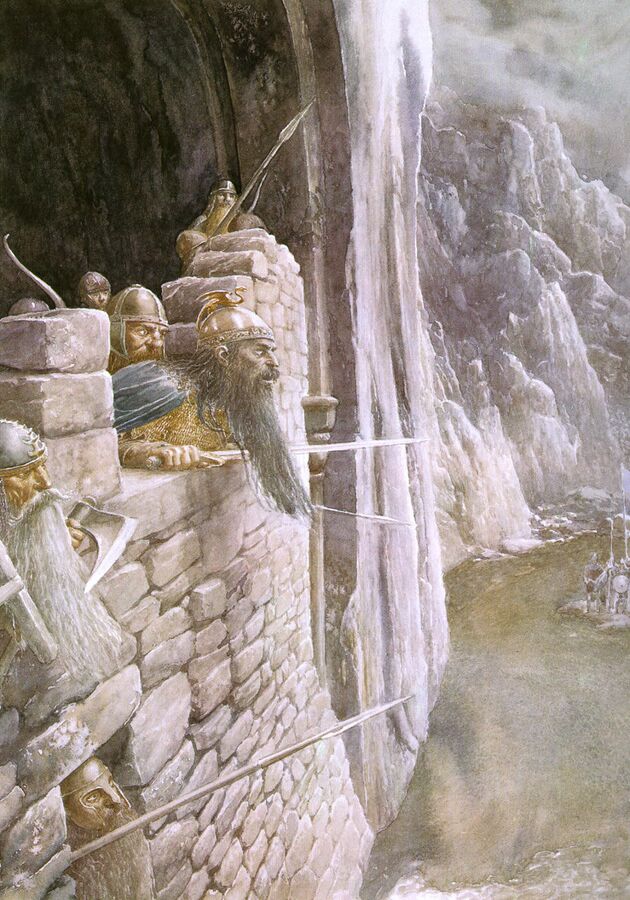
And, as with Boromir, Thorin comes to see the error of his ways. If one were inclined to be cynical, one might observe that had he remained hidden away in the Lonely Mountain until the end of the Battle of Five Armies, it is difficult to imagine any self-respecting Dwarf subsequently respecting or perhaps even serving Thorin – unlike with Boromir, it is at least possible to read his entrance into the battle as being a calculated and self-serving move (if a risky one also) intended to legitimise his kingship.
But I think it is clear from the text that such would be an unfoundedly subversive interpretation. Thorin’s subsequent deathbed conversation with Bilbo should form sufficient evidence that we are meant to understand his redemption, too, to have been full and genuine – Thorin dies because he seeks to do the right thing, and it is that seeking that forms his redemption.
Yet I think that it is due to the deathbed speech between Bilbo and Thorin that his and Boromir’s deaths tend to linger in the memory of Tolkien’s readers. In the case of the former, it is the most significant death of any heroic character in The Hobbit, likely the first work read by a newcomer to Middle-earth – and in the case of the latter, it is the first of these heroic deaths in The Lord of the Rings that is not later undone (and I will return to Gandalf momentarily!). Further, both Thorin and Boromir are permitted extended conversations with Bilbo and Aragorn respectively, in which we as readers gain something of an insight into the tragedy and the redemption of each.
It is with this idea of redemption leading to death that I wish to propose a better name for Boromir and Thorin’s deaths: the rectificatory death. For both do die in the pursuit of rectifying their own actions, and of fulfilling their duties. And they are not the only characters in Tolkien who do so. I would contend that Théoden, too, dies in rectifying himself.
Théoden is an interesting case study for the purposes of this essay, in that by the time he dies on the fields of the Pelennor, he has served as a principle heroic character across several chapters – as such, it is easy to discard his failings prior to Gandalf’s entering Meduseld, or even to think of them as failings at all. Yet, harsh though it may seem, Théoden was indeed failing in his duty and his role as King of Rohan, and thus was also failing in his moral duty. That that failure was a slow and insidious one, prompted by the malice of Wormtongue and resulting not in cruelty but in indolence does not in any way excuse Théoden himself – no more, that is, than Boromir can or should be excused for succumbing to the swift and dramatic lure of the Ring.
As King of Rohan, Théoden has a duty to lead, to protect, to advocate for his people. And it is a duty that he is failing in, plain and simple. Indeed, though Théoden’s weakness may be less overtly wicked than the desire and the wrath of Boromir and Thorin, one could easily contend that it is Théoden who does far greater harm than either of the other two. By the time Gandalf rouses the King, Rohan is beset by enemies, its captains divided and uncertain how best to respond to the danger, and many have already been slain in the battles (not least Théodred, Théoden’s only child).
Yet the apathy of Théoden does not endure. His resolve and his will are restored, and thus his commitment to his duty as sovereign. A duty that leads him from his palace to the Hornburg, where he fights in defence of his people, and then on, on to Gondor and to his finest and his final hour, relieving his beleaguered allies and falling before a mighty foe. Yes, Théoden is restored many days before his death, one cannot see his perishing as being redemptive. And yet it stems from his rectifying of his earlier weakness, and from his taking up his duty anew – from his doing of the right thing, just as with Boromir and Thorin.
And Gandalf.
Gandalf may seem a curious case to include alongside these others. Only the most uncharitable of readings could posit Gandalf as having morally failed significantly ere Moria, as being in any need whatsoever of ‘redemption.’ Yet in saying this, it must also be observed that the Fellowship only enters Moria in the first place because Gandalf advocates for it. It is Gandalf who urges that they at least consider Moria as a possibility, and Gandalf who argues in favour of it despite strong opposition from Aragorn, Legolas, and Boromir – the latter two even claiming that they will not enter Moria even if Gandalf leads them there. And unlike in the films, the path through Moria is truly Gandalf’s idea, not that of Gimli – and though the dwarf takes the wizard’s side in the debate, it must be remembered that a prime reason for his coming to Rivendell in the first place was to learn what had become of Balin and his colony.
Nonetheless, despite the misgivings of many in the Fellowship, Moria is at last attempted. But it was Gandalf who moved for it, who argued most strongly in favour of it, and who led them to it and through it. Whatever comes to pass in Moria is, in some way, the responsibility of Gandalf.
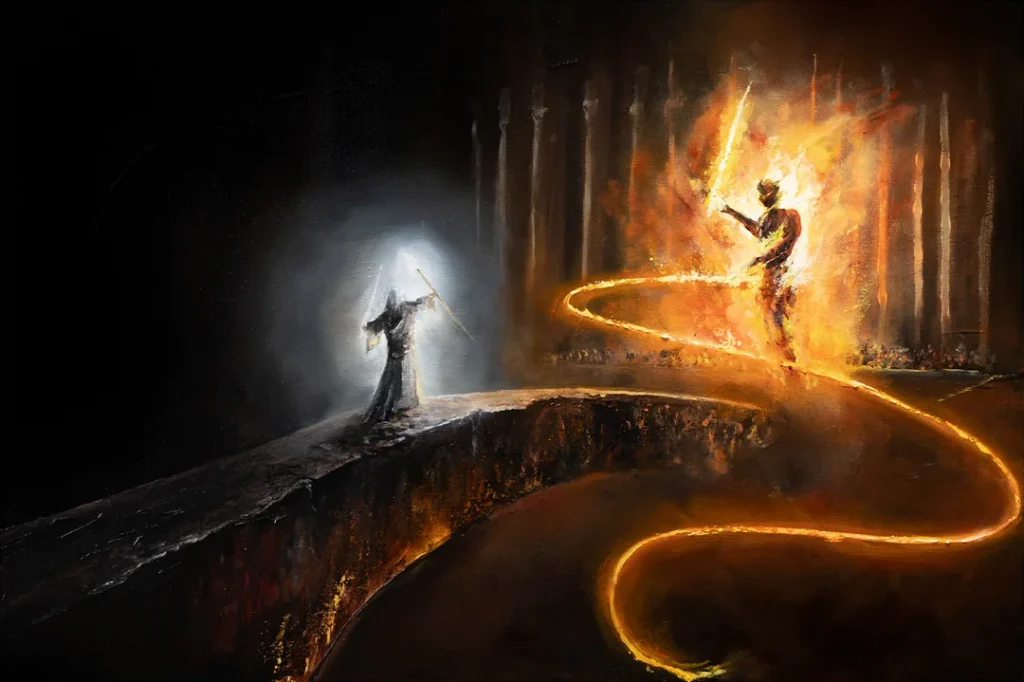
Was Gandalf the only member of the Fellowship who perhaps could have withstood the Balrog? It is very likely. But I do not think that Gandalf’s challenge upon the Bridge was merely a pragmatic exercise upon his part. Had any single member of the Fellowship perished in Moria, that death would have rested in some part with Gandalf himself, especially given the stiff opposition shown by his companions. Would Gandalf have been to blame had, say, the orc-spear slain Frodo, or the Balrog somehow caught up to Pippin? Obviously not. And yet I do think it would be fair to say that Gandalf would not have been wholly blameless for such an event, too. If anyone died in Moria, it had to be Gandalf, at least from Gandalf’s own point of view. Needless to say, it is certain that he had no intention of dying in Moria – but then again, I do not think that Boromir, Thorin, or Théoden had any intention to die, either.
No, had Gandalf not sacrificed himself to ensure the safety of his companions, it would have been a failure upon his part. Hence his death, too, is a rectification – not of a moral failure, nor even necessarily of an error of judgement, for we do not know if any other route south would have proven any better or far, far worse. Nonetheless, Gandalf bears the responsibility for Moria – and as such, also bore responsibility for its safe passage, even at the cost of his own life.
There are other characters in Tolkien who also die fulfilling their duty, but I wish to turn away from them now, and to pick up on something mentioned above – that none of these characters sought death, though they were willing to accept it. For there are other characters in Tolkien for whom this is other – and a pair of characters in particular that are rarely considered in light of each other. I wish to turn to Frodo, and to Éowyn.
They are an incongruous pair. As far as I am aware, Frodo and Éowyn never intersect within the text. Indeed, one can well imagine that neither knows anything of the existence of the other until at least after the Pelennor, and perhaps not until after the end of the War of the Ring. Their tales follow very different trajectories, and there is very little in either character that recalls the other.
Most of all, though, they may seem incongruous for being focused on in this text at all. For neither Frodo nor Éowyn actually dies in the course of The Lord of the Rings – their perishing occurring at some indeterminate point following the tale’s conclusion, peaceful and healed of their griefs suffered.
Yet it is these griefs that I think deserve some special attention. For of all the characters in The Lord of the Rings, it is Frodo and Éowyn who come to not only expect death, but to hope for it in some way.
But what Frodo himself felt about the events is quite another matter.
He appears at first to have had no sense of guilt, he was restored to sanity and peace. But then he thought that he had given his life in sacrifice: he expected to die very soon. But he did not, and one can observe the disquiet growing in him.
JRR Tolkien, Letter 246
Gollum was not the only one who expected to die when the Ring was destroyed. At the ruin of Mount Doom, Frodo, too, believes that all is over, that he will soon be consumed by fire or smoke or earth. And it is for this reason, Tolkien seems to imply, that his peace at least was thus restored.
And, of course, Frodo does not die. He is rescued, though he is not saved. And so life continues, and he endures, even as weariness and guilt (an unfair guilt, yet a guilt nonetheless, as Tolkien goes on to say in the same letter) eat at him and he fades away from the tale, such that he plays no role at all in liberating the Shire save to urge the hobbits against slaying their own, and later extends mercy to Saruman – a mercy that (through no fault of Frodo’s) is rendered naught moments later anyway.
In my previous article, I speculated that all of the Ringbearers needed to pass over the Sea to gain metaphysical succour and at last be free of its taint. But whether this is accurate or not, it is at least certain that Frodo needed this grace in order to also come to a mental and emotional peace. And, as Tolkien observed in the letter quoted above, the peace that Frodo experiences immediately after the Ring is destroyed is gained not just from the lifting of that dreadful evil from his will, but also because Frodo himself believes that the end has come for him.
And yet it does not come, and so he must continue in darkness.
Éowyn’s healing memorably occurs within the text itself – unlike Frodo, we see her come to closure through her new perspective gained through her speech with Faramir and the ending of the War. But her riding to war is itself her seeking to give her life in sacrifice, to fall in battle and thus be freed of her sorrows. Both her and Frodo are driven forward by that belief and that desire – and, on not suffering the death that they expect, they are left bereft, and must come to some new understanding of their situation (indeed, Tolkien also calls attention in Letter 246 to the idea that Frodo’s repose across the Sea would have led him to better understand his status as an agent of providence).
But there is one key difference between the characters too – Frodo expects to die doing his duty, fulfilling the task that he took upon himself in Rivendell. Éowyn, conversely, seeks her death by shirking her duty.
It is an aspect of Éowyn’s character and her arc that is not commented upon enough, I think. I have no intention of downplaying her heroism or her deeds upon the Pelennor, and will return to them! But it is terribly important to recall that Éowyn not only should not have been at Minas Tirith at all, but that in riding with Théoden’s host, she has fled from a task set for her by her uncle – to govern their people in a time of great crisis, in a time where great devastation has already been wrought and the greater part of its army is now to be absent. In slaying the Witch-king, Éowyn is derelict in her duty to Rohan.
“But she did not wish to take on that responsibility, it was forced upon her by Théoden,” I hear my strawman reader cry! Undeniably. But it is a duty that she accepted nonetheless, and a duty that desperately needed fulfilling. We have no information, either in the text of The Lord of the Rings or in any commentaries by Tolkien, as to what passed in Rohan when Éowyn rode to war. That the country was not ravaged and destroyed is at least clear enough, but we do not know whether Éowyn made arrangements in her own absence, or if she left any word whatsoever as to what had happened to her. Yet even if one takes a charitable reading and assumes that she did deputise her own deputisation, there is no escaping from the simple fact that she was wrong to do so – and that her wish for honour and death in battle was itself wrong.
I have been critical of Éowyn thus far, and do not wish to labour the point – not least because though she rides to war for the wrong reasons, she nonetheless does so in order to achieve a right end, as is made apparent from her stand against the Witch-king. If I have suggested above that Éowyn’s shortcomings are not often enough observed, I think it is also fair to say that her moment of triumph is easily underestimated by the grizzled rereader. Tolkien himself describes the Witch-king as being near-demonic through the Siege of Minas Tirith, risen to a great and terrible potency. In entering the gates of the city, Gandalf alone of the defenders stands against him – even with Gandalf there, no single soldier can bear that awful dread. Even the Balrog could not prevent Aragorn and Boromir from running to the wizard’s aid – but there are none who would oppose the Lord of the Nine.
None, save Éowyn. The mere fact of her being willing to stand firm against the Witch-king is nothing short of extraordinary…but it does also point toward a deeper moral fortitude within her. For consider – Éowyn has come to this battle seeking and hoping for death. In facing the Witch-king, it could have all too easily become a “be careful what you wish for” situation – a moment of dramatic irony and pathos as Éowyn realised her error even as she suffered a terrible and awful death.
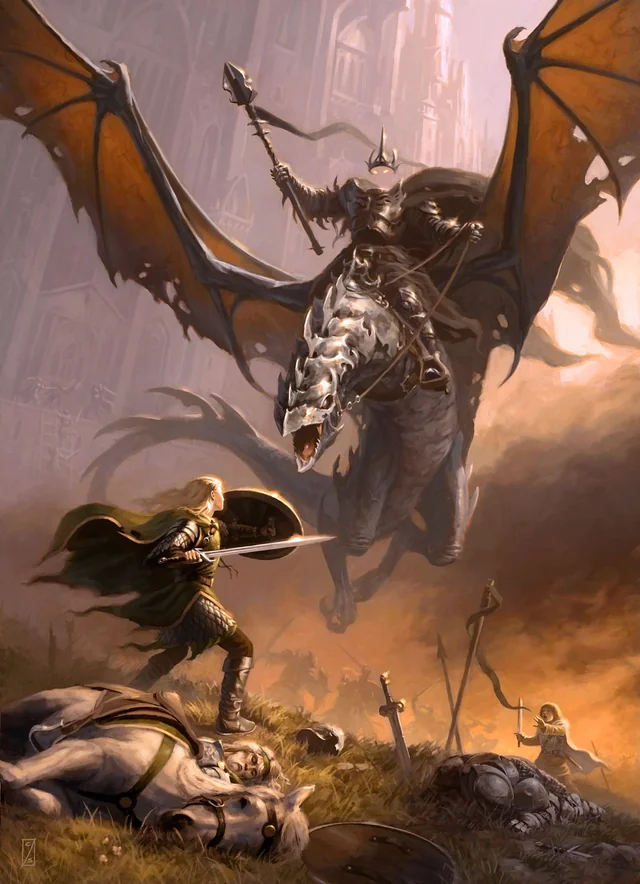
But, for all that Éowyn seeks death, she does not seek simply to die – and she has ridden forth not merely with a death-wish, but for a love of her land, and the tales of her people, and her own unrequited love for Aragorn. All of them are good loves – loves that are not illuminated with a full understanding, as is evident from her shirking her stewardship and her loving Aragorn not for who he is, but who she wishes him to be – but good loves nonetheless. And so she stands firm, and she gains greater glory than she ever could have dreamt of, and does not gain the death that she sought…but neither does she succumb to death, though Death looks her in the eye and Death shatters her arm. But she does not succumb, and I think that it is thus that her heroism is revealed, in spite of her shortcomings.
Éowyn does not succumb. But others do, and it is to them that I would now turn, especially in light of Éowyn’s heroics. For there is one major heroic character in Tolkien’s writings who also succumbs to despair at the last and takes his own life – Túrin.
If Frodo and Éowyn are an incongruous pairing, I have never come across any text that compares her to Túrin at all. Yet I think there is something informative in doing so. For, as with Éowyn, Túrin is an overtly heroic character who is nonetheless flawed. He suffers griefs beyond his own control, and he suffers griefs through his own rash deeds.
And yet they are not terribly similar characters, despite those points of similarity. And where I think that they differ is in how they rise to those shortcomings. Take, as an example, one of the earliest ills that befalls Túrin – his inadvertently bringing about the death of Saeros in Doriath. Saeros’ ill will and jibes and dishonouring of Túrin are evils beyond Túrin’s control – and though Túrin then acts poorly in his humiliating and pursuing Saeros when the elf ambushes him, even King Thingol (for whom Saeros was a chief advisor, a person high in regard within his court) concedes that the young man had some justification in doing as he did.
But it is in Thingol’s judgement that Túrin’s greatest shortcoming is revealed – for it is reached in absentia, Túrin having guessed at the consequences for Saeros’ death and fled. Yes, Túrin acted foolishly with Saeros. Yes, it was not unreasonable to fear that Thingol would have been wrathful or vengeful. But Túrin not only presumes to see the endpoint, but then fails to rise to it – fails to rise to meet that risked wrath. And as such, he is not rewarded with Thingol’s mercy.
One is reminded of Gandalf’s words many years later to Frodo in Bag End – that “even the very wise cannot see all ends.” This, I think, is where Túrin errs over and over again – he sees fit to see those ends, and so great tragedy and loss is suffered, both to him and to those near to him. Until, at the last, his despair claims him and he sees only one end left – an end tragically foreshadowed by his own father in speech with Morgoth.
“This last then I will say to you, thrall Morgoth,” said Húrin, “and it comes not from the lore of the Eldar, but is put into my heart in this hour. You are not the Lord of Men, and shall not be, though all Arda and Menel fall in your dominion. Beyond the Circles of the World you shall not pursue those who refuse you.”
The Words of Húrin and Morgoth from ‘Narn i Hîn Húrin’ from ‘Unfinished Tales’ by J.R.R. Tolkien
When Húrin says these words in defiance of Morgoth, it is a moment of triumph and hope – and yet ultimately, it is itself a foreshadowing of his son’s eventual helplessness and despair (and it is not the only time that Húrin does so): and in slaying himself, Túrin realises his father’s words in the most tragic and bitterly ironic manner possible.
And it is this, I think, that truly sets Éowyn apart from Túrin. For though Éowyn herself falls into a grave despair, and for a time seeks death, she does not allow that despair nor that death-wish to wholly claim her. If Éowyn had wished to slay herself at Dunharrow, she could have done so. It would, one imagines, have been far easier than sneaking into the king’s army, than convincing Elfhelm to allow her to ride with him, than all the days of discomfort and uncertainty in riding to a battle that may well have been lost long before they arrived, if they came to it at all. Yet Éowyn does so, because though she may be failing in her duty as a steward, she nonetheless maintains that desire to do well – and memorably, she is rewarded for it twice over, in doing what may well be the single greatest deed in any battle of the Third Age, and then coming to find the solace and healing that she needs.
I have used the word “stewardship” to describe Éowyn’s vice-regency that never was, and this is no accident – for in considering those characters who “see all ends,” one must then pass to the tragedy of Denethor. One can very easily compare Denethor with any of Éowyn, Túrin, or Théoden. It is the latter that is most often drawn in comparison with the Steward of Gondor, and it is easy to see why – Théoden falling in battle before the walls of Minas Tirith, even as Denethor retreats into his own tomb, deluded into believing that the war is lost and failing his own duty to the people of his city.
(As an aside, though Denethor and Théoden are often compared with each other, I have never seen anyone comment on a strange congruency between their treatment of Faramir and Éowyn respectively. Denethor, memorably, would have willingly immolated Faramir with himself – but in Théoden’s appointing of Éowyn as his proxy, the king was not just fulfilling a need to his people, but also putting Éowyn in as safe a place and position as could have been contrived in those dark and uncertain times. Yes, she may well have been killed eventually, as she observes to Aragorn, but until then, she is far from the war, and if the battle had gone ill, may well have been able to retreat and even escape. And yet both Denethor and Théoden are thwarted in their wishes – Faramir is saved from the pyre, and Éowyn rides to war regardless, and great good comes of both things. Cannot see all ends, indeed.)
The similarities between Denethor with Túrin and Éowyn need not be drawn out. In the case of the former, both see the end beyond doubt, and in the case of the latter, both reject their duty – but again, Éowyn’s rejection is founded in a nobility that Denethor eventually casts aside in order that he maintain the little power he still perceives himself to possess. It is worth observing, however, that Denethor’s seeing of the end is explicitly flawed – the black sails that he has glimpsed in the palantír are not Gondor’s destruction, but its salvation. Though…given Denethor’s animosities toward Aragorn, one can debate whether that knowledge would have comforted him. But that is an essay for another time.
Before concluding, one might observe that thus far, there has been a distinct lack of Elvish characters considered in this post. This is no accident. Many Elves die across Tolkien’s writings, and yet very few of them die either in reparation or in despair. Many of them die as a consequence of their own ill choices – Fëanor, Thingol, Eöl, and Maeglin all come to mind. Others, such as Finrod, Beleg, Glorfindel, and Gil-galad, die explicitly sacrificial deaths: doing some mighty deed in the aid of another. And Haldír.
I think one could argue that Lúthien, too, dies a sacrificial death, if in other manner to most. For Lúthien’s sacrifice is in taking up mortality that Beren might be returned from Mandos and yet live. As argued above, the fact that she does not immediately die does not lessen the sacrifice.
Fingolfin, perhaps, is an interesting third category – indeed, Fingolfin seems most similar to Éowyn to me. And yet Fingolfin does actually die, and this is not an insignificant difference – nor, I think, is that lack of reparative deaths among Elvenkind.
I have previously argued that the nature of Elvish free will is other to that of mortals – that the Elves are perhaps best understood as being a midpoint between men and angels, at least in a Thomistic understanding of angels and their will. In this reading, an Elvish will is not perfectly informed, but it is near-perfectly governed – hence, it is difficult and unlikely for an Elvish will to change or deviate.
I do not think that it is thus a coincidence that Elves tend not to die in some sort of atonement for their deeds – to do so would require a changing of that will, which is something that comes (perhaps too) easily for Men, and that is difficult for Elves. And in further evidence of that, I would offer the last surviving sons of Fëanor and their end as being a case study, after they have stolen the Silmarils from the Host of the Valar:
But the jewel burned the hand of Maedhros in pain unbearable; and he perceived that it was as Eönwë had said, and that his right thereto had become void, and that the oath was vain. And being in anguish and despair he cast himself into a gaping chasm filled with fire, and so ended; and the Silmaril that he bore was taken into the bosom of the Earth.
And it is told of Maglor that he could not endure the pain with which the Silmaril tormented him; and he cast it at last into the Sea, and thereafter he wandered ever upon the shores, singing in pain and regret beside the waves.
The Silmarillion, Chapter 24, ‘Of the Voyage of Eärendil and the War of Wrath,’ by J.R.R. Tolkien
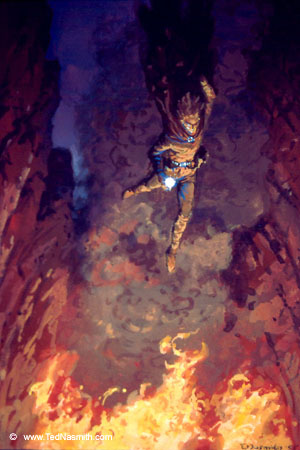
Both are driven by the oath that they swore alongside their father to recover the jewels. Maedhros, who urges Maglor to the fulfilling of that oath, at last understands that it truly cannot be fulfilled – his will is illuminated with new knowledge. Yet even now, he cannot bear himself to part from the jewel, and so he slays himself.
As for Maglor, he already was unwilling to pursue the Oath to its end, and must be pressed to it by Maedhros. Yet pressed to it he is – and, though it is not written in the Silmarillion as published by Christopher Tolkien, there are several sources from JRR that state that Maglor, too, eventually cast himself into the Sea and was lost.
Neither dies in reparation for the evils done by them or their kin. Both realise the futility of their oath only upon fulfilling it, and both are driven to a despair that claims them. A despair that, as with Fingolfin, is total and unrelenting, and so they act upon it and are lost.
In bringing this far-too-long text to a close, there is one final case I wish to consider – a case that brings us back full circle in this September Series. For there is a third character in The Lord of the Rings who, as with Éowyn and Frodo, chooses death – and yet unlike Éowyn and Frodo, actually does die as a result of that choice.
For it is not untrue to say that Arwen Half-elven chooses death. Yes, it is death for love, there is no despair in her choice, unlike with either of the other two characters. And yet it is death nonetheless. And it is clear that, come the end of Aragorn’s life, Arwen at last understands the bitterness of that choice. It is not to say that she would ever have chosen other, and yet it is clear that she understands the regret bound with that choice.
And further, Arwen forms yet another fascinating complement with both Éowyn and Frodo. For it is the very existence of Arwen that drives Éowyn to her own grief, when she comes to realise that Aragorn is pledged to another and will not have her. And it is through Arwen that Frodo first learns that he may yet be permitted to find solace and rest across the Sea.
And so Arwen accepts the gift granted to her father’s line and elects to be counted among mortals. And, many years later, she sits with Aragorn as he dies, and then dies herself, alone in an abandoned and cold land.
It is a strange and disquieting end to a story that is so concerned with hope. But I do not know that The Lord of the Rings could have ended any other way. It is a story about Death. There are many works of fiction in which death is important: in which characters die and in which death plays some central role. But Death is so woven into the very fabric and theme of Middle-earth that, ultimately, I do not think it could have ended any other way. And it is, however ironically, that very fascination with and consideration of impermanence, loss, and death within Tolkien’s writings that has ensured the endurance of his works across many generations.
But Arwen went forth from the House, and the light of her eyes was quenched, and it seemed to her people that she had become cold and grey as nightfall in winter that comes without a star. Then she said farewell to Eldarion, and to her daughters, and to all whom she had loved; and she went out from the city of Minas Tirith and passed away to the land of Lórien, and dwelt there alone under the fading trees until winter came. Galadriel had passed away and Celeborn also was gone, and the land was silent.
There at last when the mallorn-leaves were falling, but spring had not yet come, she laid herself to rest upon Cerin Amroth; and there is her green grave, until the world is changed, and all the days of her life are utterly forgotten by men that come after, and elanor and niphredil bloom no more east of the Sea.
“The Tale of Aragorn & Arwen,” from Appendix A of The Return of the King, by J.R.R. Tolkien
~~~~~~~~~~~~~
Thanks for reading – feel free to check out anything else you may be interested in on the blog, there’s plenty more to discover! Follow me on Substack, Facebook and Twitter to stay up to date with The Blog of Mazarbul, and if you want to join in the discussion, write a comment below or send an email. Finally, if you really enjoyed the post above, you can financially support the blog, and keep The Blog of Mazarbul running. Thanks for reading, and may your beards never grow thin!
